Published June 2026
Aso-Ebi Started as a Way to Show Family Bonds. Here's How It Became a Financial Pressure Point Instead
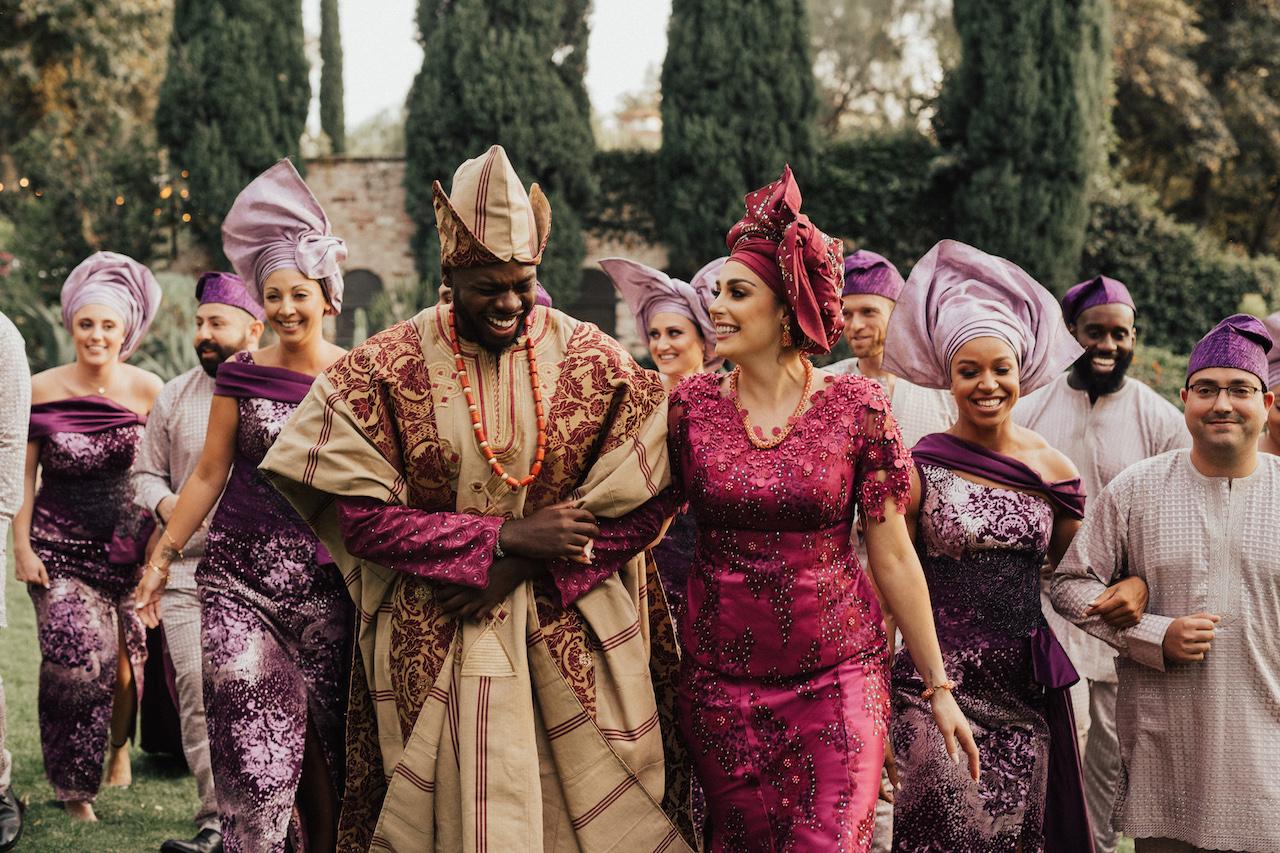
Aso-ebi — the coordinated fabric worn by guests and family at Nigerian celebrations — is so ubiquitous today that it's easy to assume it's always functioned the way it does now: a fashion statement, a cost guests budget for, sometimes a source of genuine financial strain. Its origin was considerably narrower, and tracing how it expanded explains a lot about the tension around it today.
What the word actually means
Aso-ebi comes from the Yoruba words for "cloth" (aṣọ) and "family" (ẹbí) — literally, family cloth. The original purpose was self-identification: a way for blood relatives, or members of the same age-group, to visibly signal their connection to one another and to the person being celebrated, whether at a wedding, naming ceremony, or funeral.
It started as something closer to a fraternal uniform
Researchers tracing the practice's history point to two related origins: Nigerian economic historian Ayodele Olukoju dates aso-ebi's emergence as a recognisable social phenomenon to around 1920, during a post–World War I economic boom driven by rising palm oil prices, while anthropologist William Bascom traced an earlier root to Yoruba age-grade groups, where members of the same generational cohort wore uniform dress specifically to mark their fraternal bond. Either way, the earliest versions of the practice were tightly bounded — restricted to blood relations or a specific defined group, not open to anyone who wanted to participate.
How the boundary dissolved over the 20th century
Interviews with elders in Ibadan, recorded by researchers studying the practice's evolution, describe an early 20th-century shift where aso-ebi began to be referred to as ankoo ("uniformity") or egbejoda ("group uniform") — terminology reflecting a move away from blood ties as the defining requirement. Over subsequent decades, participation expanded well beyond family circles to friends, colleagues, and well-wishers more broadly, with the practice eventually spreading from Yoruba culture to other Nigerian ethnic groups and beyond — into Cameroon and Sierra Leone, for instance, where it's sometimes practiced today as "ashobi" by communities largely unaware of its specifically Yoruba origin.
Why the expansion changed what aso-ebi actually does socially
When aso-ebi was restricted to family or a defined age-group, the cost and obligation were bounded by that same group — a known, finite circle. As participation opened up to anyone who wished to show support, the practice increasingly took on a second, less discussed function: communicating social worth and status, not just solidarity. Academic researchers studying the modern practice have documented this directly, describing how aso-ebi shifted from pure identification toward a marker of how much a guest values their relationship to the celebrant — a shift that helps explain why what began as a bonding ritual is now, for many Nigerians, a genuine and openly discussed financial pressure point, particularly during a busy wedding season with multiple aso-ebi obligations stacking up.
The honest throughline
Aso-ebi's core meaning — visible solidarity and belonging — hasn't actually disappeared; it's simply operating at a much larger scale than it was designed for, with a financial dimension layered on top that wasn't part of its original, family-bounded form. Understanding that history doesn't resolve the modern tension around cost, but it does explain where that tension actually comes from: not a corruption of the tradition, but a fairly direct consequence of the same tradition succeeding at scale.
Keep Reading
Related Stories
6 Aso-Ebi Colour Combinations Nigerian Brides Are Actually Choosing in 2026
Emerald and gold. Wine and champagne. Royal blue and silver. Here's an honest, practical breakdown of the colour pairings actually dominating Nigerian traditional weddings this year — and how to choose between them.
Read moreLace, Aso-Oke, and Sequins: An Honest Guide to Nigerian Bridal Fabric Choices
Choosing bridal fabric in Nigeria isn't just about look — it's about climate, occasion, and how the fabric actually performs across a multi-event wedding day. Here's a practical breakdown.
Read moreThe Real History of Money Spraying — And Why It's Technically Illegal
Money spraying dates back over a century to Yoruba praise-singing traditions. It's also, on paper, against Central Bank of Nigeria regulations. Here's the full, slightly contradictory story.
Read more